Dou Shou Qi
Animal ranks
-
1
Rat 1
-
2
Cat 2
-
3
Dog 3
-
4
Wolf 4
-
5
Leopard 5
-
6
Tiger 6
-
7
Lion 7
-
8
Elephant 8
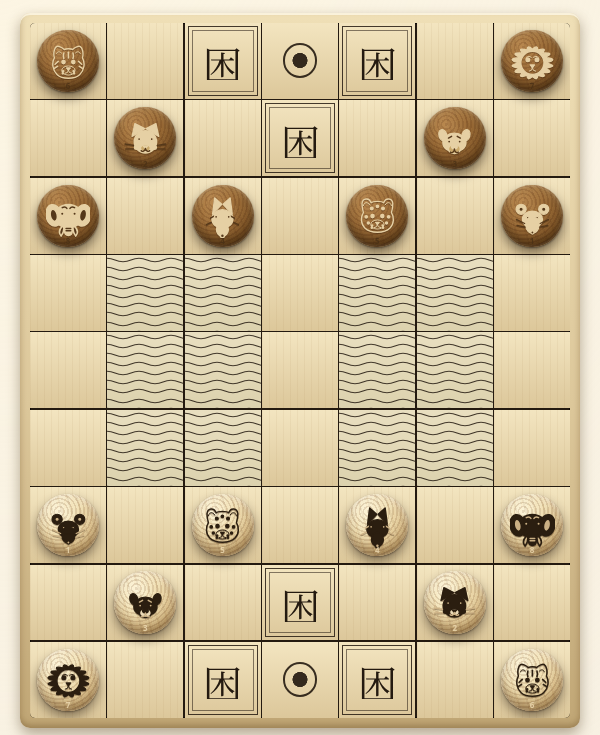 Initial position: both armies face each other across the river.
How to play
The board has seven columns and nine rows. Each player starts with eight animals on the marked squares. The first player moves first.
Your goal is to move an animal into the opponent's den. You also win if your opponent loses every animal or has no legal move. A player with no legal move loses; the game does not end in a draw.
Moving
Move one square up, down, left or right. Diagonal moves are not allowed. You cannot enter your own den.
Capturing
A stronger animal can capture an opponent's animal of equal or lower rank. The rat can capture the elephant on land, but the elephant cannot capture the rat. The elephant can capture a rat only when that rat stands in an elephant-side trap.
River
The two rivers each cover three rows and two columns. Only rats can enter the water. A rat in the water can capture, or be captured by, another rat in the water. A rat in the water cannot capture an animal on land, and a land animal cannot capture it.
Lions and tigers can leap straight across a river and land on the first square on the other bank. They can capture an eligible enemy animal on that square. A rat in any water square along the path blocks the leap.
Traps
Each den has three nearby traps. An animal in an opponent's trap has rank zero. It cannot capture other animals, and any opponent's animal can capture it. Your own traps do not weaken your animals.
This game uses wolf at rank 4 and dog at rank 3. Some editions reverse those two animals.
General Statistics:
- games played.
- victories and draws.
- average movements per game ( max: , min: ).
- victories by the first player vs victories from another player.